ELEVEN
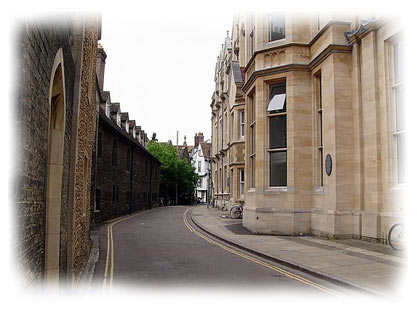
OUTSIDE THE CAVENDISH LABORATORY
It was a foul night. The clouds that had chivvied Lord Peter on his way back from Trinity swelled still more ominously as evening approached, and shortly before midnight they let down their burden with a savage fervour. Peter and Bunter huddled in the car outside the Cavendish Lab, watching the windscreen wipers bow and straighten, like tipsy gentlemen in frock coats, to a hypnotic rhythm at odds with the African drums of the rain. At each passage, a brief window opened in the distorting stream of water, and they peered anxiously through in search of their quarry, although, as Peter observed, the chances were he would have chosen an early night in preference to wetting his wings from ranging in the rain. "Which is," he added, "a jolly good principle, and it is only my extreme devotion to duty that is keeping me here in this tin box in the middle of the most dreadful downpour it has been my misfortune to experience. The rain it raineth on the just, and also on the unjust fellow, but chiefly on the just because the unjust is safely tucked up in bed awaiting more favourable weather conditions."
At around one in the morning, however, the rain eased off, exhausted by its orgy, and after approximately the amount of time it would take to shin down a stretch of ivy, scramble over a wall and cycle from Christ's to the Cavendish, a single light came gliding towards them from around the corner of Downing Street.
As the bike approached, Peter switched on the headlights and Free School Lane lit up like a stage. The cyclist flung up one hand to shield his eyes from the glare, and braked sharply, then yanked the front wheel around, with the evident idea of fleeing back the way he had come. His foot was already depressing the pedal, when the hand of Bunter fell heavily upon his shoulder, and the voice of Lord Peter fluted through the raindrops.
"Why don't you get in the car, Mr Kuryakin? It's a vile night, and we'd be happy to give you a lift."
Kuryakin bestowed on his lordship a look of indescribable sullenness, and hesitated, as if considering his options. Apparently he concluded that he had none, for, although his face did not change, he turned to the door Wimsey was holding open for him and wriggled into the passenger seat.
"That's the ticket," said Wimsey cheerfully. "You hop in the back, Bunter, and we'll go for a spin. Dear me, we're just in time, it looks as if the rain is starting up again. Now then, Kuryakin, I expect you're wondering what an eccentric old duffer like me wants from a young scientist like yourself."
"I can guess," said that gentleman grimly.
"Oh, you can, can you?" said Wimsey. "I'd be rather surprised if that's true, but I'll tell you what, I'll give you three tries, in the approved fairy tale manner. If you get it right, Cinders, you shall go to the ball."
"And if I don't?" said Kuryakin, staring fixedly out of the side window.
"Well, if you don't, then I suppose I shall have to tell you. Don't worry, you won't be turned into a pumpkin or anything, I'll just be rather impressed if you do guess correctly, because I'm inclined to think you're probably barking up the wrong tree. I'll tell you what, let me make three guesses first, and then you can have yours. Dr Black contacted you before he died, didn't he?"
Kuryakin stiffened perceptibly but said nothing.
"It's all right," said Lord Peter easily. "You have the right to remain silent, but anything you do say will not be taken down and used against you. Now for guess number two: Black accused Sir John Duffield of ripping off Alan Turing's research and publishing it as his own. I see from the frown and wrinkled lip that I've hit another jackpot, so you needn't break your silence on my account. Guess number three: you think I'm here to institute a cover-up on Sir John's behalf, the pillars of the Establishment standing shoulder to shoulder to defend their own, my country right or wrong. But actually nothing could be further from the truth. I come to bury Caesar, not to praise him. I will concede that Sir John did ask me, in a roundabout sort of way, to get your residence permit revoked and pack you off back to Mother Russia – and I'd like to know exactly what you did to arouse his suspicions – but unfortunately for him, I'm more a detective sort of bloke than a politician. I did a bit of snooping around and found out rather more than I was supposed to."
He glanced sideways at the young man, who was still staring rigidly out of the window, the personification of scepticism.
"I'm not going to let him get away with it," Wimsey said softly.
The Allegory of Scepticism did not soften in the slightest. Lord Peter felt a curl of irritation.
"Look, I tell you, I'm not involved in this in any official capacity. Whether you help me out or not, nothing's going to happen to you. But it would make it very much easier to put Duffield in check if you could see your way to telling me exactly what Black told you."
In answer to this, Kuryakin glanced down at the door handle, then his head swivelled round towards the imposing bulk of Bunter in the back seat. For a moment his eyes flickered back and forth between Bunter and the door, and then, with the air of a political martyr submitting to the secret police, he put his hand inside his jacket pocket and pulled out a folded piece of paper. This he passed to Wimsey, all the while carefully avoiding looking at him, in a very thorough and deliberate snub. Peter unfolded the paper and read the contents aloud for Bunter's benefit, noting, by way of introduction, that the letter was typewritten.
27 May 1955
My dear Illya,
Pardon me for taking the liberty of writing to you like this, but I do not know where else to turn. By the time you read this letter, I shall have crossed into that undiscovered country from whose bourne no traveller returns, and perhaps the world will be a better place for it; I cannot honestly say that anyone but my dear Mother will regret my passing.
If you had not been careful to avoid me this past week – I know you were, you need not trouble to deny it – I should have told you the full story. Or perhaps I am just fooling myself. I like to believe that you would have understood, but perhaps you would have felt no more than contempt or, worse, pity. That I could not have endured. But I must get to the point.
Please understand that what I am about to tell you is in no way the result of personal animosity towards Sir John Duffield. It is true that I opposed his appointment as Master. I believed then, and I now know, that his values are antithetical to this institution. Science can only be truly served in a spirit of humility, of selfless dedication to theory and fact, and not as a means of personal advancement. I have no doubt that Sir John will "raise the standing" of this College. As to what he will raise it to, that, I fear, is less certain. He is – I must speak plainly – a liar, a cheat and a thief, without honour, without scruples and without morals.
I wish you could have known Cambridge as it once was. When I was a young man, it was a place dedicated to ideals: ideals of friendship, of scholarship, of love. Nowadays it seems treachery, greed and self-advancement are the guiding principles, and it is men like Sir John who have brought us to this state.
It has been my misfortune to stumble across evidence of exactly how low he will stoop to achieve his ends, but when I confronted him with this, I found myself outplayed. I cannot explain myself more fully, I can only ask you to take it on trust that I would not have abandoned this crusade had my hand not been forced.
You will have heard, I am sure, of Alan Turing. You will also have heard what happened to him - the whole world has. After his disgrace, he contacted me to ask my assistance with some research he was pursuing, and for the sake of our long-standing friendship, I agreed. I was naturally reluctant that knowledge of this association should reach other ears, and Alan was very much in a mood to retreat from the world; besides which, the topic - the development of cryptographic algorithms for computing engines - touched on areas that he had been legally prohibited from pursuing. I am certain, given these circumstances, that no-one beside ourselves was aware of the work we were doing. I repeat, no-one knew of this work. Yet shortly after Alan's death, Sir John Duffield delivered an important paper on exactly this topic to the Royal Society, on the strength of which he was elected a Fellow. I have procured a copy of this paper and satisfied myself that there is no element of it which is original. It is all drawn directly from work Alan Turing did, with some minor input from myself, in the autumn of 1953.
You will forgive a condemned man a brief descent into melodrama, but this cancer at the heart of Christ's must be cut out. Expose the scandal to the world, and it will destroy the perpetrator, as all things of darkness shrivel and die when they are exposed to the light. I cannot do it. You must believe me when I tell you that Sir John Duffield is as guilty of my death as if he had pulled the trigger himself. All hope of justice rests now with you, Illya. I swear I am telling the truth and I shall seal that oath with my blood.
Yours etc.
Gregory Black
"So you were invited to apply for the job of avengin' angel," said Wimsey, on finishing this curious missive. "How did it arrive, by the way?"
"I found it in my pigeonhole the morning after he died," said Kuryakin. "It must have come in the university mail."
"And what did you think of it?"
"I didn't know what to think. It seemed so utterly bizarre."
"It didn't occur to you he might simply be off his rocker?"
"It did cross my mind. But if he was mad, he must have gone insane very suddenly, because I'd talked to him on several occasions and he always seemed very rational. Not very pleasant, but rational. And then, he was actually dead, so that part at least was true."
"So that meant you felt obliged to do something?"
Kuryakin shrugged, in a rather French manner, as if to say this were far too complicated an issue to be addressed in mere language.
"But you did do something?" persisted Peter, "Even though you didn't know Black well and had no idea if he was telling the truth? Rather selflessly noble of you."
Kuryakin scowled at the street outside, but said nothing.
"I don't suppose," said Wimsey in frustration, "that you have any idea why he picked you?"
For the first time Kuryakin turned his head to look directly at him, his eyes blue and guileless. "It beats me," he said, the slang expression sitting oddly with his accent. "I thought he couldn't stand me. He started an argument every time we met."
There was a slightly strained silence. In the back seat, Bunter shifted uncomfortably but kept his counsel.
"And yet you took up the torch," said Wimsey at last. "Why? You must have had a reason."
Kuryakin hunched down in his seat. "I was curious," he said defensively, "so I got hold of a copy of Duffield's Royal Society paper, and it was true that it was a significant departure from his previous work."
Lord Peter nodded appreciatively, and Kuryakin, apparently encouraged, became more forthcoming. "After that I kept my eyes on him, to see if he showed any signs of a guilty conscience, and I think he must have noticed, because he started watching me back. I would look up from eating in Hall and find him staring at me. And once I came back from the Lab early, because I was feeling unwell, and met him coming down my staircase. I mean, he's the Master and he can go where he likes, but I know he wasn't visiting anyone else on the staircase, because all the oaks were sported, except Carruthers', and Carruthers said no-one had knocked on his door. That struck me as odd, but I didn't see what I could do about it, and anyway, it was hardly evidence of plagiarism. And then you turned up, and Duffield was so anxious to stress that you were his friend and that you worked for the intelligence services, and I remembered Black's letter, and that Duffield had had some sort of hold over him, and I was afraid he might have something similar in mind for me. So I thought I had better satisfy myself once and for all whether Dr Black had been speaking the truth, and I looked into Turing's files to see if there was anything corresponding to Duffield's paper."
"And there wasn't, of course," said Wimsey, "but there were great big gaps in the files. And that struck you as suspicious."
"Yes. But I couldn't get all the way through them in one night – there are boxes and boxes of the things – so I came back to have another look. And you caught me."
He cast a sideways look at Lord Peter, as if to see how he was taking it. "What happens now?" he asked. "You said you weren't going to let Duffield get away with it. What do you have in mind?"
Lord Peter's long fingers tapped the steering wheel, producing a rhythm that the musically inclined might have recognised as the Radetzky March but which was, nonetheless, rather wearing on the nerves. "We need to find those files," he said thoughtfully. "It seems to me that a spot of law-breaking is called for. Oh, don't look so shocked, Kuryakin, we aren't going to inflict any damage on persons or property, but I should very much like to have a squint inside Duffers' private safe, and though I have friends in high places, I don't believe that under the circumstances any of them would oblige me with a search warrant. If we're going to do anything, it will have to be a private initiative. And you know, since heaven has thoughtfully provided us with an occasion when we can be certain the Master's Lodge will be unoccupied – the May Ball, you juggins - I think it would be rather ungrateful of us not to carpe the diem."
"But we don't know where the safe is," objected Kuryakin.
"Ah, now that I think," said Lord Peter, indulging in a rare twinkle, "is a task for Bunter. Bunter, do you think you could employ your manly charms to prevail upon Duffield's housekeeper to reveal where the safe is?"
"Mrs Winterbottom?" said Bunter, a trifle doubtfully. "I should not like to lay odds on it, my lord. She strikes me, if you will excuse the expression, my lord, as a right old tartar. I fear she may prove unsusceptible to the blandishments of the male sex."
"A garden closed is my sister, my spouse? A spring shut up, a fountain sealed? But she must have succumbed at least once, you know. Surely you won't let yourself be outdone by Mr Winterbottom, May-He-Rest-In-Peace?"
"I shall endeavour as always to give your lordship satisfaction," returned Bunter grimly, and Peter smirked.
"In that case we may count on success," he said to Kuryakin. "You may not think it to look at him now, but Bunter was once the terror of Piccadilly. No housemaid was safe from him. Like Joshua, he blew his trumpet and down went all before him."
Here he broke off. Kuryakin was regarding Bunter with a dubious eye, as if uncertain how to categorise a man who preyed upon helpless female members of the proletariat. Peter sighed. Kuryakin was undoubtedly a worthy young man, but like all these blasted Bolshies, he was tiresomely lacking in a sense of humour.
"What about you?" he said. "Are you up for it?"
Kuryakin stared out of the car window at the streaming rain. It was hard to tell what he was thinking. Peter supposed he must at least be pondering the consequences to his scientific career if he should be caught attempting to burgle the Master's Lodge. Certainly he would be sent back to Russia, and what would happen to him then was anybody's guess. It struck Peter, somewhat belatedly, that it wasn't entirely fair to involve Kuryakin in a crusade where the stakes were so much higher for him than for anyone else. He had already taken a great deal of risk in going through Turing's files. Asking him to rifle Duffield's safe as well was going too far.
"I don't want you doing any of the actual breaking and entering," he said firmly. "Although I'd appreciate your help as a distraction, if that's all right with you."
"All right," said Kuryakin slowly. "What will it involve?"
"Good man," said Peter warmly. "Now tell me, do you have a dinner suit? I thought not. I'd lend you one of mine – you're about the right height – but I fear it would be rather tight across the shoulders. And my tummy, alas, isn't as trim as it once was. Duffers and I have that much in common. I think Bunter had better take you shopping tomorrow. No arguments –" as Kuryakin raised his voice in protest – "It's the May Ball tomorrow night, and we'd be fools to pass up such a God-given opportunity for burglary. But you can hardly mingle with the crowds looking as if you'd just escaped from Woolworth's. It's evening dress or nothing. Come on, you can swallow that Socialist pride for once in a good cause – in for a penny, in for a pound, if you'll forgive the capitalist metaphor. And now let's get out of this filthy rain and go home to bed. We can work out the details in comfort tomorrow."