TWO
IN THE FELLOWS' GARDEN
Lord Peter returned to his rooms after the match to find Bunter debating the relative merits of charcoal grey versus anthracite socks as High Table attire. "Although since the College was victorious, my lord, I venture to recommend the grisailles as indicating a desire to share in the general esprit de corps."
"Charcoal will do fine," said his lordship, with the air of a man with a mind above socks. "Bunter, I don't suppose that by any remote and unlikely chance you packed my magnifying monocle, did you? All right, you needn't look so beastly smug about it. Wait, I feel a prediction coming on. You have brought the fingerprint powder and the insufflator as well. Tell me, Bunter, do you have a little crystal ball that you consult before hauling out the suitcases? Or do you sit up of nights, communing with juggling fiends? Because I don't see how else you could possibly have known we were going to need all this stuff. We haven't used it for years."
"I have long admired Lord Baden Powell's maxim that one should always be prepared, my lord," replied Bunter, throttling every hint of excitement with the ruthlessness of a thuggee.
"You are a wonder of nature," said Lord Peter admiringly. "When you die, they will pickle your remains and put them on display for posterity to gawp at, like a domestic Julia Pastrana."
"Am I to understand, my lord, that something in the nature of a detective case has aroused your interest?"
"You are, and it has. Do you know, Bunter, I thought I'd had enough of murder, what with the war and all that, not to mention corpses rudely forcing themselves on my attention wherever I went. Things have come to a pretty pass when a chap can't even go on his honeymoon without a cadaver dancing attendance. But it seems that exclusively serving the lares and penates loses its charm after a while."
"Perhaps, my lord, the domestic tranquility that arises from all the young gentlemen being away at school is proving rather too tranquil for your lordship's temperament?"
"I daresay you're right. At all events, since one of the College Fellows has been obliging enough to expire of a gunshot wound in the Fellows' Garden, let us not look a gift case in the mouth."
"Indeed not, my lord. Perhaps your lordship would care to supply further details of the matter?"
His lordship certainly did care to. Bunter listened attentively to Peter's description of Black's death and the arrival of the anonymous letter. "Not that it made any direct accusations," Wimsey hastened to add. "It just said 'Kuryakin KGB. Ask Black.' But Duffers has understandably got the wind up about it."
"If we are treating the case as murder, am I to understand that you lend credence to this letter, my lord?" enquired Bunter. Wimsey groaned.
"Goes against the grain to ally oneself with poison pens, doesn't it?" he said. "I suppose we could set out to prove it was suicide, which I regret to say is prima facie the more likely explanation, and therefore not much of a challenge, but it would at least give us the satisfaction of putting a spoke through our chap's wheel. Still and all, Bunter, I'd rather look for villainy. Even if Black was murdered, the deed could perfectly well have been committed by someone other than Kuryakin. Perhaps them what done Black in, done him in, if not for a hatpin, then for some other low, personal motive. Did he perhaps pen a particularly vicious article rubbishing a rival's claims to intellectual superiority? Did he snatch the prize for the Fattest Marrow from the usual holder at the St Neot's annual fête? There are manifold motives for murder beyond the political, and men have died and worms have eaten them without the KGB being involved. I say, here's a thought – what if the letter was written by the murderer himself, to divert attention from his role in Black's defunction? In that case we should have the satisfaction of not only clearing Kuryakin's good name, but also of bringing the poison pen to justice. I feel very much better about this now. All are my scruples fading away. In fact, I declare myself of the homicide party. And you, Bunter, had better stick up for suicide, in order that our combined perspectives retain a degree of impartiality. And now, since you have very clairvoyantly brought the kit, shall we shog? I am in the mood for a little gentle snooping, and the Fellows' Garden awaits."
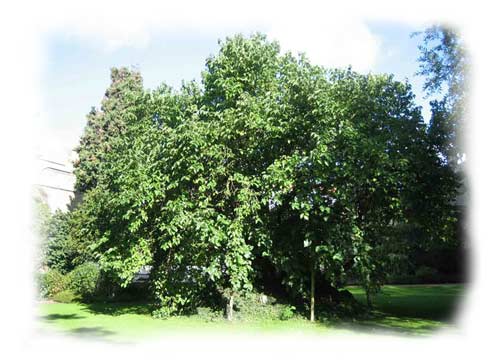
The snooping proved a most satisfactory activity, Wimsey being of an age when the sight of a fine herbaceous border does more than even cricket can to justify God's ways to man, and the Fellows' Garden sported several exceptionally impressive specimens of the genre. It was a fine breathing evening, trembling on the verge of full summer, and what with the humming of the bees and the birdsong and the heady scent of flowers, it was hard to imagine a more delightful spot. The old stone walls which enclosed the garden on three sides – the fourth wall being provided by the dignified 17th century beauty of the Fellows' Building – gave it a hortus conclusus feel, and, as a sort of bonus for the historically inclined, there was the remarkable old tree to admire, under which John Milton had supposedly composed some of his more unreadable poetry.
"With nectar pure his oozy locks he
laves,
And hears the unexpressive nuptial song,
In the blest kingdoms meek of joy and love…"
Lord Peter recited helpfully, in case Bunter should not be familiar with the more inspiring parts of Lycidas, and then broke off to add, "And this must be where Black rested his own oozy locks just before pulling the trigger. See the discolouration on the bark? And that hole in the centre must be where the bullet went in. Dug out by the police, I suppose. Shame, I should have liked to have seen it. I say, it went in quite a way, though, look how far I can poke my finger in! I wonder where he got the gunpowder from? Duffers says the bullets were stored with the pistol in the SCR, but I can't imagine they kept a handy packet of gunpowder in there with it. Shockingly lax security, don't you think? I'm surprised dozens of Fellows haven't been slain when feelings run high after a particularly tense meeting of the Governing Body. Ah well, at least Black enjoys the privilege of having been the One and Only. Dead in his prime, young Lycidas, and hath not left his peer. I wonder what else we can find?"
The answer to that rhetorical question was: disappointingly little. There were no signs of anyone having lurked within the Garden's walls. The aforementioned fine herbaceous borders were entirely devoid of incriminating footprints, and Milton's Walk, the passage outside the wall which marked the boundary of College territory, entirely failed to show marks such as might have been made by an individual leaping from the wall onto the ground.
"If there was a murderer, it must have been a College member," said Lord Peter, aware that he was clutching at straws. "No-one else could have gone through the main gate out of College without being noticed."
"I thought all College members were accounted for at the time of Dr Black's death, my lord?"
"Quite right, Bunter. All were foregathered for merry-making in the Hall. But one must not forget that Duffers, bless his democratic little soul, is an Athenian. When he thinks of College members he thinks upon the free men and the citizens, and not upon the women and the slaves. Doubtless the Junior and Senior members were all present and correct, snouts in the trough, but what of the bedders, Bunter? What of the porters, the gardeners, the kitchen staff? What if the College Butler did it? Besides, it had to be someone who could sneak into the SCR and liberate the pistol without attracting undue attention."
"The kitchen staff and the butler would have been on duty during Formal Hall, my lord, and it would have been a matter of some note had a bedder or a gardener still been on the premises so late in the evening. The second porter, however, is a different matter. I shall make enquiries as to who was on duty that night."
"Do that, Bunter mine, and I shall betake me to the local police station and demand a copy of the report."
Regrettably, the police report proved as uncooperative as the Fellows' Garden to the eager seeker after homicide.
"We can narrow down the time of death to within a few minutes, my lord," said the helpful young constable on desk duty, "on account of Mr Croft having been very conveniently entering the vicinity just as the shot was fired. There's not many corpses as is so helpful in that respect."
"Most obliging of him," agreed Lord Peter. "And did the convenient Mr Croft also see the victim pull the trigger?"
"Unfortunately not, my lord, owing to a clump of trees having got in the way, but then I daresay the deceased had picked a secluded spot specially. He wasn't shot by anyone else, my lord, if that's what you're thinking, because the doctor could tell from where the bullet went in – it's this bit of the report here, my lord – 'The angle of entry is consistent with the victim having inserted the pistol into his mouth with his left hand before firing'."
"And Black was left-handed?"
"He was, as has been testified to by…let me see… oh yes, Mr Bell, his lawyer. And Mrs Winterbottom, the Master's housekeeper."
"The Master's housekeeper? What on earth did you need to interview her for?"
"Well, we didn't really need to, my lord, but she insisted. She's one of those ladies who it's hard to refuse, if you know what I mean. Anyway, her late husband was the College boatman, so she knew Dr Black was left-handed from seeing him out punting."
"She sounds like a bit of a dragon," said his lordship, who was not above exploiting the bonds of male solidarity in the service of Truth. "But in spite of her expert witness, did you dust the pistol for pawprints, just to make sure it was Black who fired it?"
"Of course, my lord," said the young constable, not in the least offended. "Clean as a whistle, it was. Apart from Dr Black's prints, of course."
Here, at last, Wimsey thought, was a tiny discrepancy, the minutest crack in the story of suicide. The pistols, after all, had been Milton's own, proudly displayed in the SCR. Surely the College Butler must have taken them down occasionally, if only to give them a good polishing? The complete absence of any prints but Black's suggested that someone had deliberately removed evidence of their own handling of the pistol.
At least the police had not missed the implications of the murder weapon's historic status. The helpful constable was eager to explain to Lord Peter Wimsey that the Cambridgeshire force was even now pursuing the question of where the gunpowder necessary to fire the shot might have come from. Not a chemist in the county would be immune from their scrutiny, although they had not, as yet, turned up one who remembered selling gunpowder to a recent customer.
"And you can be sure they would if anyone had, my lord," said the constable, "for it's not as if gunpowder's in high demand around here, except for firecrackers when Bonfire Night's coming up, which of course it wasn't, it being May. But if anyone should, I shall be sure and let you know, my lord."