THREE
A TOUR OF THE MASTER'S LODGE AND DINNER IN THE HALL
The Cricket Club dinner began with drinks for all in the Master's Lodgings, a pleasantly opulent building situated opposite the Porters' Lodge in First Court. Lord Peter, who had been invited early in order that he might show his appreciation of the interior architecture, gave an approving whistle as he was ushered into the drawing room.
"I say, Duffers, this is a bit of all right," he said, flapping a hand at the broad magnificence of the chimney piece. "Early sixteenth century, isn't it? Who was the clod who covered up the outside with all that Italianate rubbish?"
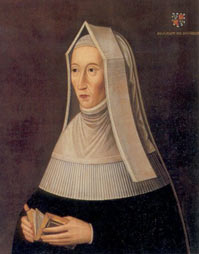
"I rather like it myself," said Sir John, "but then I'm not a historian. If it's sixteenth century you're after, let me show you the upper rooms. They were built for Lady Margaret Beaufort when she founded the College, so they go back to the early 1500s. Watch your step here, the staircase is rather uneven. This is her oratory in here - no spiritually-minded lady could be without one in those days, of course – and look, I always think this is rather fun, it's a private window opening into the chapel, so she could look down on the undergraduates at prayer without distracting them with sinful thoughts."
"Lady M. must have had a very good opinion of her own appearance," observed Peter. "Have you got any more of these secret bits, Duffers? I love a good hidden passage. And it's the sort of thing a prudent Master might have constructed during the Civil War, you know, in case the Roundheads came a-knocking.
"The King observing with judicious
eyes,
The state of both his Universities,
To Oxford sent a troop of horse; and why?
That learned body wanted loyalty:
To Cambridge books he sent, as well discerning
How much that loyal body wanted learning."
"As a matter of fact," said Duffield, refusing to rise to the bait, "the undergraduates of Christ's were as a loyal a body of Cromwellians as you could hope to meet. The little beasts still use that as an excuse for not standing up when the Fellows enter Hall, you know. They probably gave the poor Master some uneasy nights, which may explain why the main bedroom is located over the antechapel. It's good to know I shall be able to nip down the turret staircase and fling myself before the altar when the revolution comes, though what good that will do me in these godless days, I'm not entirely sure."
For all the disapproval in his words, his tone was fond, and Wimsey smiled.
"Finally getting a feeling for tradition, Duffers? Most unlike you. I thought you were all about Progress and the New."
"In science, yes. There's no excuse for getting fossilised there. But I don't mind a few cultural relics in College life. It adds a touch of flavour, don't you think? Look, if you poke your head out here, you can see a remarkably fine stained glass – oh!"
"What's up?" said Wimsey, pulling his head back in. The Master held out the window latch for his inspection, a queer expression on his face.
"It just broke off in my hand," he said. "I suppose it was bound to happen sooner or later. Goodness knows how old it is. Still, it's a bit of a shock. I rather thought College buildings lasted forever."
"Heavens no, take it from me, anyone in charge of an historic pile like this is engaged in perpetual battle with the forces of entropy. You should see the annual repair bill for Duke's Denver."
"I shall inform the Bursar," said Sir John, still frowning. "I hope this isn't an omen that College is about to collapse around our ears."
"Change and decay in all around I see," said Wimsey, with the lugubrious satisfaction of a dentist examining a financially promising set of teeth. "Just regard that thingummy you're holding as a memento mori in the proper sixteenth century fashion, say a few Hail Marys and forget about it."
Sir John shook himself. "I think," he said, "I have been watching too much cricket. It depresses me to see athletic young men sprinting across the field like greyhounds. It reminds me that I'm a decrepit old codger with a dicky ticker and a tendency to gout."
He pulled so gloomy a face that Lord Peter could not help but laugh. "Thank goodness for the life of the mind, eh?" he said consolingly. "At least the old grey matter keeps churning away, whatever state the rest of one may be in. Anyway, I think it's dashed tactless, your blithering on about decrepitude and decay to a man of my advancing years. I had much rather live in blissful ignorance of what time hath wrought, which is why there is no looking-glass in my bedroom. So long as there is a spring in my step and a song on my lips, I care not a fig for that fell sergeant and all his little minions. Come on, you'd better buck up if you're going to show me the rest of the Lodge before the heroes of the hour arrive. Oh blast, that must be them coming now, with ever so airy a tread. We'll have to put off the grand tour till later."
It was indeed the First Eleven whose arrival Wimsey had discerned, their high spirits drawing tolerant glances from the Fellowship, who were following more sedately behind. Not content with having masterminded the seating arrangements for dinner, Sir John hastened to introduce Lord Peter to Kuryakin the very second the latter turned up.
"My dear boy, have a spot of sherry," he said thrusting a glass in the young man's direction. "Have you met my old friend, Lord Peter Wimsey? He was a great cricketing man, in his youth – I daresay you've heard of Wimsey of Balliol? No? Well, he was very taken by your performance on the cricket pitch this afternoon. He enjoys a good match when he isn't sleuthing around on Her Majesty's Service. Will you excuse me a moment, Flim? I must just go and bend the Dean's ear about the fireworks for the May Ball. I really don't think they're secure in the cellar of B Staircase, there are too many spare keys floating about." So saying, he flitted off to mingle, satisfied that duty had been done.
"Dear me," said Lord Peter conversationally, "does the College have a problem with pyromania?" He spoke light-heartedly, but Kuryakin seemed to take it with the same lack of humour that had characterised all Peter's contact with Bolsheviks and their sympathisers. Not that he looked particularly Slavic, resembling neither a horny-handed son of an agricultural cooperative, nor, in spite of the surname, a scion of the Russian aristocracy. His was hair as pale as Peter's own, and his eyes neither grey nor slanting, but a curiously Aryan blue. His clothes, however, were another matter. Poverty might have excused his suit, which was cheap and ill-fitting, but not the gown, which was evidently third or fourth hand, and had been torn at some point and the rip inexpertly mended. It was worn with a provocative air that said the owner did not care a single damn for such outmoded English traditions as academic robes.
This attitude appeared to encompass the younger sons of Dukes as well. Beyond an evidently insincere, "It is a pleasure to make your acquaintance," it proved difficult to draw more than a monosyllable of conversation from him. Wimsey, who had started the evening feeling well-disposed towards the young man, found his stock of goodwill rapidly diminishing. As each of his overtures was rebuffed, he felt himself slipping unwillingly into a persona he thought he had grown out of years before.
"Jolly old place, Cambridge, what?" he said. "Bet it makes a change from Mother Russia. Don't you feel homesick at all?"
"I miss the plumbing," said Kuryakin coldly. "But sacrifices have to be made for the privilege of working with some of the finest minds in my field."
"So no complaints, then? Been treating you well, have they?"
"No and yes. Thank you."
"Food decent?"
"Yes."
"Making friends all right?"
"Yes."
All in all, it was a relief when, after some half an hour of sherry-drinking and congratulatory chit-chat, the College Butler announced that dinner was served, and the celebrants proceeded along a private corridor directly to Hall. After the beauties of the Fellows' Garden and the Master's lodgings, Peter was disappointed to discover that the Hall had been "improved" by those tireless modernizers, the Victorians. The sombre wood panelling and beams sorted ill with the black-and-white tiled floor, and the eminent Christ's alumni, whose portraits gazed down upon the diners, seemed to a man to be frowning their displeasure at what had been done to their domain in the name of progress.
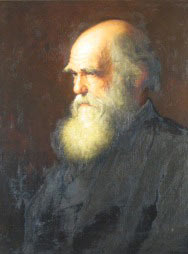
Thanks to Sir John's manoeuvrings, Wimsey found himself once again next to Kuryakin, seated directly beneath a portrait of an elderly Charles Darwin, whose beard was so long, and rendered with such loving attention to detail, that his lordship was rather afraid he would find bits of it floating in his soup.
The evening was, taken all in all, a rather depressing experience. The food was designed more to encourage academic excellence than sybaritic ecstasies, and the conversation consisted of the usual High Table more-erudite-than-thou one-upmanship, with the additional frisson of traditional Oxbridge rivalry to give spice to the drawling display of learning. The young, he had been warned, would be boisterous, having wiped St John's eye in a fair fight. Wimsey hoped there would not be any bun-throwing. At his age, that sort of thing no longer seemed as much fun as it once had, and he was relieved when it became apparent that the euphoria of victory was expressing itself in nothing more damaging to the dress than a few riotous songs.
The Man of the Match, seated to his left, observed the hilarity with an air of sullen disapproval that Peter found rather provoking.
"Nice to see young people enjoying themselves, what?" he bellowed into Kuryakin's ear, over the noise of a particularly vulgar rendition of the Eton Boating Song.
"High Table certainly offers an excellent vantage point from which to observe the benefits conferred by a public school education," responded the Russian. Were it not for these outbursts, one might have thought him shy; but having been on the receiving end of rather more pieces of blistering sarcasm than was comfortable, Peter suspected it was camouflage. It seemed that, since pumping was getting him nowhere, he would have to try more direct methods.
"Nasty piece of business with your Maths Fellow," he observed.
There was no getting away from it. Kuryakin jumped, then followed up this suspicious reaction by shooting Peter a glance that was quite evidently startled. On Peter's right, the Master bent a less obvious ear in their direction.
"Odd thing, his leaving no suicide note," said Wimsey, laying out the bait, his gaze never wavering from his neighbour's face. "Makes one wonder if there was anything funny going on. In my experience suicide without any kind of parting note is very unusual, even if it's only a 'Farewell, cruel world,' sort of thing. One may still turn up, of course. What do you think?"
Kuryakin's face was unnaturally devoid of expression, as if he had pulled on a mask, but his eyes slid past his interrogator and on to the Master. Sir John, caught blatantly eavesdropping, chose to brazen it out and met his gaze full on. Kuryakin blinked hastily away and dropped his eyes to his plate. From that moment on, he refused to be drawn into any further conversation, his attention apparently fully occupied by the task of grappling with his beef bourguignon.